Zevon Blog
My Ride's Here Sessions
By Klint Macro
klint@cobblestudios.com
March 7, 2026
Private Island Trax recording studio was located at Crossroads of the
World in Hollywood and owned by engineer/producer Michael McDonald (not
the dude from the Doobie Brothers). Private Island Trax was a very cool
studio; the folklore was that it was originally built by Crosby, Stills,
and Nash, at least that was what I was told. It had a great sounding "A"
studio with a 48 Channel DDA console with Neve Flying Fader automation.
I was an independent contractor engineer/producer and was working around
town (whoring) at several small to mid-range studios. In 2000, I was doing
a lot of sessions at "The Island". It was within walking distance of where
I lived and at that time Michael treated me very well. That was when I
first met Warren.
Warren was working on My Ride's Here and wanted to work with Michael,
although their schedules could not align. Michael recommended that Warren
work with me; he would be in good hands with the 26-year-old kid. I met
with both Warren and Michael briefly, talking about music-y stuff and
Warren decided to book dates.
On the day of our first session, I was playing some music on the nearfields
while I was waiting for him. I can't recall exactly what I had playing,
but it was likely Van Halen or maybe Lyle Lovett. When he walked in, I
moved to shut it off and he said, "You can let that play for a minute."
I grabbed him a coffee as he sat down behind the console and began to
rock in his chair.
My thing at this time was to draw pictures of the instruments on the console
tape. The console tape is a strip that goes below the faders where you
label what each channel's track is; Kick Drum, Bass Gtr, Warren lead Vox,
Vox Harmony, Rhm Gtr, Piano, Dave Letterman... etc. It took a bit of time
to create these modern art masterpieces, and I would do it before the
session started, so that I was not billing clients for the time it took
me to doodle on the console.
Seeing him continue to rock in his chair, I asked, "is everything OK dude?"
He said, "Yeah, and I like what you did here," pointing to the console
tape. I explained that it was my "thing," and I enjoyed drawing it out
as part of my pre-session prep. He shook his head in the affirmative and
began to rock again. After a few moments, he stopped rocking and said,
"I need you to do me a favor." Anticipating that he was going to ask me
to take the label off or something else, I was surprised when he said,
"re-do this, but I need the drums to be green, bass, guitars, and keys
to be red, and the vocals to be black. Can you do that?" I said, of course,
however, I'd hate to waste 10-15 minutes of your time drawing pictures.
He said, "It won't be a waste of time, go ahead and do it."
I stripped off the tape and replaced it, grabbed a few different colored
Sharpies, and began drawing. Warren asked if I could use a pack of cigarettes.
We clarified my brand of smokes, and he left for the 7-11 across the street.
When he came back, the new console tape was on the board. He tossed me
a pack of smokes, sat down behind the console, and inspected my work.
He exhaled, smiled, and said, "Very nice, let's get to work!"
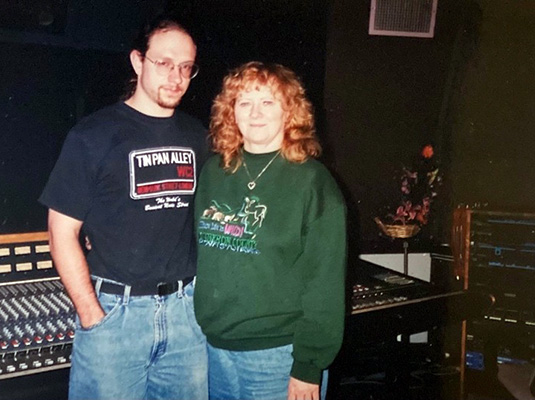
(Above) Klint Macro, pictured with his mother, Carol Graham, circa 2001
in the control room of the "A" room at Private Island Trax.
The recording of the instrumentation for "The Hockey Song" was
VERY inconsistent with the other masters. Warren recorded the music as
a live pass on the stage at The Ed Sullivan Theater with the Late Show
Band. We recorded the vocals at Private Island Trax as an overdub. As
I recall, I flew in the Dave Letterman Samples with a mini disc player,
and the master was on 2" analog 24 track. I don't believe there were any
"slave" tapes to afford additional tracks.
There was a tremendous amount of drum bleed in the piano mics. Not only
were the tracks inconsistent with the tonality of the other songs, but
as it was recorded live on stage, the insolation from one track to the
other was certainly lacking. It was suggested that the song be re-recorded.
Warren was adamant that he would not retrack it. It was then suggested
that Warren re-track the piano. There was a beautiful Yamaha C7 in the
"A" Studio, but Warren did not want to retrack the piano. None of the
other engineers involved with the album wanted to mix "The Hockey Song."
So, Warren said, "Kid, do you want a crack at it?" Which of course I said,
"hell yes!"
Michael would pop into the control room while I mixed the song. Afterall,
it was HIS studio. He would tweak a compressor or push a fader, and gave
advice, but I mixed the shit out of that track. It was MY mix. We mixed
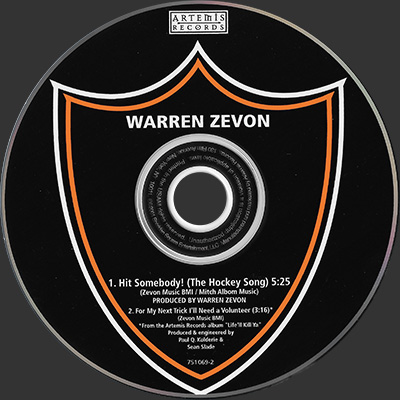
"The Hockey Song" or as it was later called, "Hit Somebody" on October
24, 2000 from 1130 a.m. till 1130 p.m. Warren was such a great storyteller,
I wanted the music to act as a vehicle to convey the story, like a movie
soundtrack... ut the story was in the vocals. I put Warren's vocal out
front as the focal point. Afterall it was HIS song.
Taking mixes out of the studio is generally discouraged or in many cases
forbidden. I made a CD burn of the Hockey Song that I snuck out of the
studio that night. I marked the disc with a black sharpie and the letters
"WZ" in the shape of the Van Halen logo. This was my only copy until Artemis
released My Ride's Here in 2002. The "WZ" disc was stolen out of
my car in a binder with a bunch of other CDs in 2001. So, if you ever
find a CD-R in a bush with "WZ" in the shape of the Van Halen logo near
De Longpre Ave in Hollywood or at a thrift store somewhere... let me know.
I recorded/engineered not all but a LOT of vocals on the My Ride's
Here album. To the best of my recollection, I want to say I "hit the
red button" on several lead vocals and a hand full of backing vocals.
I really enjoyed working with Warren and it was a tremendous opportunity.
He was a true professional and an incredible wordsmith. He was passionate
about his music. He knew exactly what he wanted to hear, but he was also
open to creative suggestions. When we were done, he looked me in the eyes,
shook my hand, thanked me, and gave me a couple hundred bucks for a tip.
Warren was a good dude!
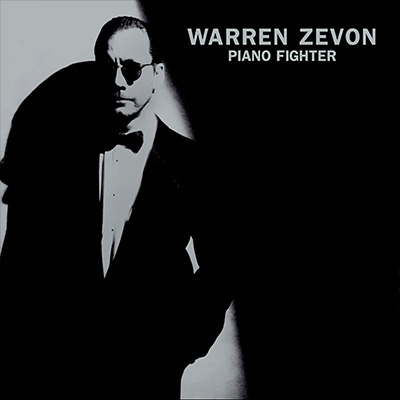
The Making Of Piano Fighter: The Giant Years
by Adam Unger
August 11, 2025
The Concept
In early May 2024, Matthew Block and the team at Warner/Rhino reached
out to the Zevon team, proposing a box set covering Warren's years at
Giant Records for an upcoming Record Store Day exclusive release. The
immediate appeal was apparent; all three albums were long out of print.
Mutineer and Learning To Flinch, both released during the
heyday of compact discs, had never been available on vinyl. Mr. Bad
Example previously had its lone vinyl release in Germany, that version
now considered a collector's item. Bonus tracks and additional live material
were considered, but ultimately proved cost prohibitive as the box was
already four vinyl discs.
The Title
How do we sum up this era of Warren's career with a title that is
both on brand with his catalog and commercially viable? The obvious choice
was simply The Giant Years, but everyone involved wanted something
more creative. Inspired by the last decade of David Bowie album box sets
from Parlophone, I sent song titles and lyrics as potential candidates.
Chemin De Fer anyone? Jordan had the best solution; Warren's friend,
author Carl Hiaasen should name the set. Carl and Warren had become fast
friends during this period, leading to the duo writing Rottweiler Blues
and Seminole Bingo. Carl wrote back quickly with the title Piano
Fighter, a song that debuted first on the live album Learning To
Flinch followed by a proper studio version on Mutineer. Many
thanks to Carl and his team for lending a hand.
Reconstructing History
As sometimes happens with reissues, original artwork and photography
may be missing or lost from archives as record labels fold and/or consolidate.
This is not a problem localized to these three Zevon albums; graphic artists
are tasked to recreate album artwork accurately. Rory Wilson did an excellent
job on art direction, collaborating with all of us at Team Zevon to ensure
fonts, logos and colors were recreated accurately from the highest quality
source materials. No detail was overlooked from text kerning to size to
color.
Mutineer proved to be particularly troublesome; the best quality
source was the original CD sized artwork. Sometimes you can get lucky;
the original photographer may have negatives, transparencies or high-quality
copies. The cover photography for Mutineer is credited to none
other than Serenus Zeitblom, a character from Thomas Mann's novel Doktor
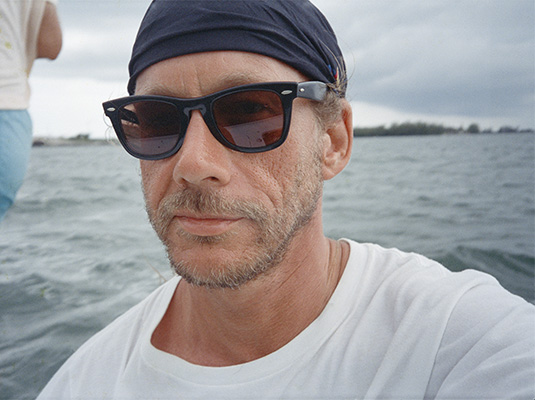
Faustus. The actual photographer was the artist himself, Warren Zevon,
pioneer of the selfie decades before the first smart phone.
I recalled the image was taken during a fishing excursion with Carl Hiaasen,
which Carl was nice enough to corroborate. Jordan Zevon is always accommodating
when I need pictures, stories, leads and anything else he can provide.
Another trip to the storage space was on tap with the hope of finding
the needle in the haystack.
After digging through multiple storage totes of pictures of Warren with
anyone and everyone, including Waddy Wachtel, Eddie Van Halen, Hunter
S. Thompson, Johnny Depp, Meryl Markoe and Cybill Shepherd, a text came
my way, "cross your fingers cause I think I just found the negative
to Mutineer." Written in black sharpie on a Ritz Camera store
envelope, "Mutineer Tarpon Fishing."
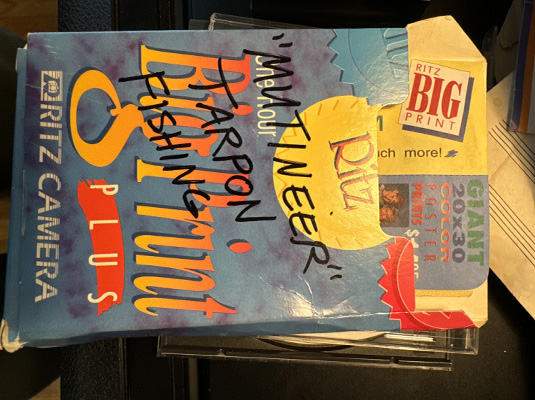
Enclosed were strips of negatives, one clearly marked by two post it notes.
The original image was found, Warren sporting a white T-shirt which had
been altered for the final album release.
The Sound
Warner Brothers' audio archive is second to none; their team has every
tape meticulously logged, photographed and ready at a moment's notice.
Half-inch analog mix reels for all three albums were perfectly preserved.
Learning To Flinch and Mutineer were originally recorded to DAT and then
transferred to 1/2" mix reels at the time. Even for albums that were primarily
released on CD, this extra step was often taken for final mastering. Lacquers
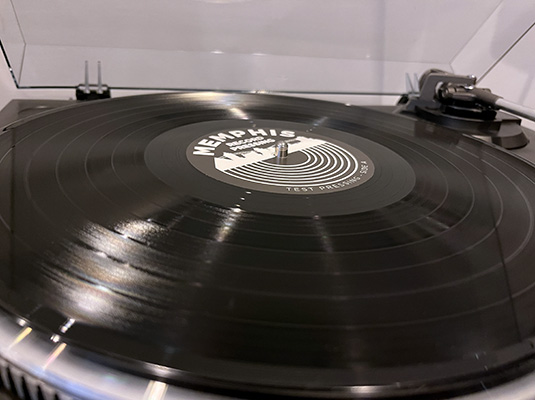
for this project were cut from the original 1/2" analog reels by
Bernie Grundman. Multiple test pressings were pressed and critiqued for
the most minor of imperfections. Once approved by Team Zevon, production
began.
Warren's Story
During a conference call with Rhino, the subject came up to include an
accompanying booklet with the set. Matt Block raised the question to Jordan,
"who would you like to write this, do you have a journalist in mind?"
Jordan immediately answered, "Adam will do it."
I worked with Queen's Official Archivist Greg Brooks on similar booklets
for the band's 25 album vinyl collection released in partnership with
Unviersal Music and DeAgostini in 2018. Greg's added workload due to the
Bohemian Rhapsody biopic provided the opportunity to assist on
half the albums in this series which were released initially in Italy
and expanded to Japan, Chile and Argentina. This later led to Greg and
I co-writing text for Queen's The Miracle (Collector's Edition)
in 2022.
Greg and I used band quotes to great effect to frame the story of each
album; we filled in the accompanying facts and missing pieces. For Piano
Figher, I used the same method. Warren wasn't around to tell his story
but there was enough archival material to piece it together. I used 35
newspaper and magazine articles from the time, all with insightful interviews
from Warren. Thankfully he wasn't shy sharing insights on the creative
process with the press; this and his dated diary entries proved to be
invaluable.
Finishing Touches
Additional material from this era may provide matieral for future
deluxe releases. Warren's personal cassettes do contain early versions
and home demos of tracks like Finishing Touches (originally titled A Hard
One To Love). Mostly complete soundboard recordings also exist of live
shows , most notably the excellent 1990 An Enemy Of The People Tour
backed by Gurf Morlix and Dan Dugmore. Nearly 100 DAT live concert recordings
still exist and are safely in storage from the Learning To Flinch
concerts. Hopefully we will revisit those one day. For those who missed
out on Piano Fighter, each album will be released individually
before the end of 2025 on vinyl. Until then, it looks like for the next
project we might send The Envoy...